

When a Protest is an Insurrection and an Insurrection is a Protest
As Orwell taught us, controlling the people requires controlling language. This is what we see playing out in the battle over the term "insurrection."

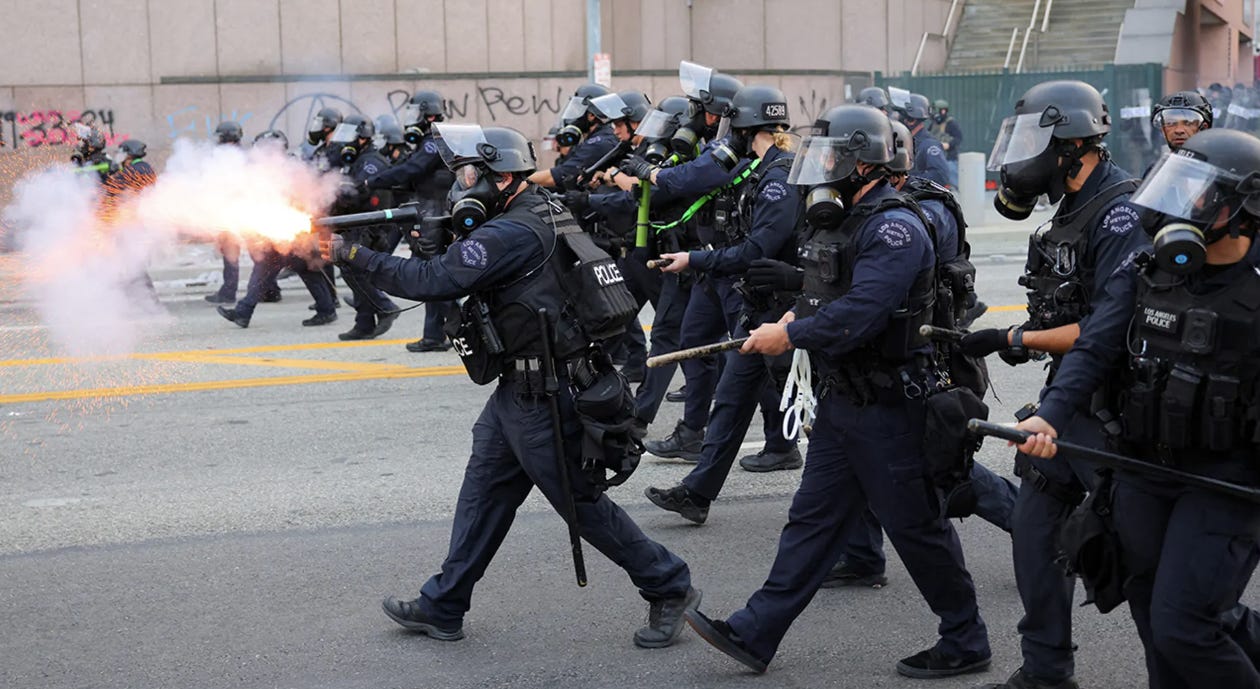
As authorities struggle to get the riots in Los Angeles under control and anti-ICE unrest spreads across the country, President Donald Trump is reportedly considering invoking the Insurrection Act of 1807, which allows the president to deploy the military to suppress an insurrection or other public disturbances that obstruct the execution of federal laws.
Calling the protesters “violent, insurrectionist mobs,” Trump has so far declined to formally invoke the Insurrection Act, stressing however that he remains open to the idea. “If there’s an insurrection, I would certainly invoke it,” he said. “We’ll see.”
White House Deputy Chief of Staff Stephen Miller has been less equivocal in his remarks, claiming that California Gov. Gavin Newsom and Los Angeles Mayor Karen Bass are stoking “violent insurrection” by urging the withdrawal of military forces in Los Angeles.
“The Mayor of LA is effectively saying the mob violence is caused by the mere presence of ICE in the city, and the violence against ICE will not stop unless federal law enforcement is withdrawn from the city. This is the definition of insurrection,” he wrote on X.
The term “insurrection,” of course, has both a colloquial and a legal definition, on one hand used rhetorically to forcefully condemn unruly protests and on the other hand to formally authorize the lawful use of active-duty military or federalized National Guard troops to enforce the law, and it’s not always clear in what sense the term is being used.
But it should be said that whether or not the current unrest meets the legal standard appears somewhat irrelevant, since the Trump administration has already deployed the National Guard and Marines to Los Angeles, disregarding the wishes of the governor and mayor, and seemingly overriding the Posse Comitatus Act, which prohibits the military from acting in a domestic law enforcement capacity.
On Friday, the Marines made their first detainment of a protester while defending the Wilshire Federal Building. Explaining the authority that enables the military to make such arrests, Maj. Gen. Scott Sherman did not invoke the Insurrection Act, but simply said that if federal personnel are assaulted, “Soldiers or Marines are allowed to take that person, detain them in place, wait for the federal law enforcement officer to come and arrest that individual.”
With troops already on the ground acting to one degree or another in a law enforcement capacity, it appears that the federal response to the riots is treating the situation as an insurrection in a de facto sense even if the law of 1807 has not been officially invoked. This has drawn strong criticism from civil libertarians, with the ACLU’s National Security Project director, Hina Shamsi, calling it a dangerous abuse of power.
“It’s really recklessly undermining our foundational democratic principle that the military should not be policing civilians,” Shamsi said.
Others on the left, however, appear more concerned by the very use of the term “insurrection” – whether colloquially or legally – to describe the unrest than they are with the legalities of deploying the military on American streets.
An Insurrection?
Liberals seem to bristle at the fact that this term is being appropriated by conservatives, with much of the criticism appearing to have more to do with narrative control than it does with the lawfulness of deploying military units on American streets.
Not only do they question Trump’s motives and falsely emphasize the “overwhelmingly peaceful” nature of the anti-ICE protests, rejecting the notion that they might constitute a riot – much less an insurrection – liberals appear to understand that their preferred term to describe Trump supporters and particularly what happened at the U.S. Capitol on January 6, 2021, is now being employed against them.
For instance, Aaron Blake, writing at CNN, has downplayed the violence in Los Angeles and chastised “Trump and Co. [who] see themselves surrounded by insurrections.” Accusing Trump of employing a “broad definition” of the term “insurrection,” Blake explains that “merely protesting or even engaging in violence while doing so doesn’t automatically make something an insurrection.”
In contrast, Blake points to the January 6 riot as a bona fide insurrection, arguing that “there’s little doubt that it met the definition.” Noting that the term generally means “a violent revolt or rebellion against the government,” Blake insists that “the attack on the US Capitol was a violent attempt to effectively change the makeup of that government by overturning the election result – and by attacking an actual seat of power.”
While the implication is that Trump is hypocritical for not recognizing the events of J6 as a true insurrection while insisting that the anti-ICE rioters are the actual insurrectionists, this criticism is somewhat pedantic since the legal definition of insurrection is broadly understood as a violent uprising against U.S. authority or laws. If this were to apply properly to the congressional certification of the 2020 election, then it would certainly apply to the lawful use of Immigration and Customs Enforcement to deport illegal aliens.
The term insurrection appears specifically in 18 U.S. Code § 2383, which spells out the punishment for “Whoever incites, sets on foot, assists, or engages in any rebellion or insurrection against the authority of the United States or the laws thereof.” In explaining this provision, the federal criminal defense attorneys at the law firm Eisner Gorin LLP note that, as opposed to rebellion, “insurrection often involves acts intended to overthrow, disrupt, or challenge the authority of the United States or impede the enforcement of federal laws.”
There is no doubt that if the four-hour protest at the Capitol, which briefly paused the certification of the 2020 election, constituted an insurrection, then so too would the nationwide immigration protests, which have employed sometimes shocking levels of violence to hinder the enforcement of federal immigration law.
Common Language
While this might satisfy the legal definition of insurrection, the layman’s usage of the term is perhaps more important in a political sense. Typically applied to organized, sustained, and violent rebellions against established governmental authority, the classification of a protest as “insurrection” rather than “riot” or “rebellion” often depends on the scale, intent, and perceived threat to the state.
Historically speaking, an insurrection characteristically involves an organized group of citizens taking up arms or engaging in coordinated acts of defiance to disrupt public order, express grievances or demand political change. In American history, some of the most famous insurrections include Shays’s Rebellion of 1786–1787, in which thousands of farmers and veterans protested against state authorities, the Whiskey Rebellion of 1791–1794, which was seen as the first test of federal authority under the new Constitution, Nat Turner’s Slave Rebellion of 1831, and John Brown’s Raid on Harpers Ferry in 1859.
While none of these rebellions could be neatly compared to either the J6 Capitol siege or the ongoing ICE riots, the widespread and militant nature of the immigration protests would probably be closer to the historical definition of insurrection than the one-off riot at the Capitol four and a half years ago.
This is especially the case since many of the participants in these riots have the expressed aim of overthrowing or challenging the ruling power, whether it’s the antifa militants who dream of an anarchist revolution or the Mexican nationalists who want to reclaim the territory of the American southwest for the government of Mexico. While the J6ers were protesting what they considered to be a fraudulent and illegitimate election, the anti-ICE protesters are rejecting the very authority of the federal government to enforce immigration laws.
But although the definition probably more closely applies to the ICE riots than to the J6 riot, the elite commentariat is pushing back forcefully on the notion that what we’re seeing today is an insurrection.
“Yes, there has been some violence in the last few days as federal immigration authorities round up criminals and regular folks alike in deportation sweeps,” Anita Chabria wrote last week at the LA Times. “But 99% of this city is business as usual, with brunches and beach walks and church and yoga classes.”
Calling it “the insurrection that wasn’t,” Chabria noted that even in the downtown area where the protests are concentrated, it’s not nearly as rowdy as the situation on the streets “after a Lakers game.”
Similarly, writing at The Nation, Laura Jedeed insists that “what [she] saw in LA wasn’t an insurrection,” but rather “a police riot.”
“Yes, cars were set on fire in one part of the sprawling, multi-block protest,” Jedeed reluctantly concedes. “Yes, fireworks were launched at cops—a handful, sporadically. But it should be noted that these were launched long after these police officers began unloading flash bang after flash bang, rubber bullet after rubber bullet, into a largely peaceful crowd.”
So, essentially, the unrest is less significant than a sports celebration and whatever violence that has been unleashed against law enforcement officers has been done in self-defense. Therefore it’s not an insurrection, according to the liberal class.
Definitions and Doublethink
The takeaway from all this is that no one appears particularly interested in using terms like “insurrection” accurately or consistently. After shrieking for nearly five years about the January 6 “insurrection,” liberals are now doubling down on their language while simultaneously minimizing the violence that we see taking place in American cities, which appears to have left at least one person dead and has injured some two dozen police officers.
Conservatives, meanwhile, are clearly trying to seize the use of this term and showcasing leftist violence in an attempt to downplay the short-lived “insurrection” that took place in early 2021. What is clear then from both sides is that narrative control is more important than reality.
This reflects a general recognition that in order to maintain and wield power, controlling language is essential. As George Orwell explained in 1984, totalitarian rulers dominate their subjects through thought control, which is enabled by systematic manipulation of the English language. This is achieved in the book through a language developed by the ruling party called Newspeak and a mind-control process called doublethink.
Referring to the ability to hold two contradictory beliefs in one’s mind simultaneously and accept both as true, without recognizing any contradictions or hypocrisies, doublethink is a form of mental discipline enforced by the totalitarian regime, allowing individuals to align their thoughts with the Party’s ever-changing propaganda and reality.
Much like the battle over the definition of “insurrection,” doublethink enables the Party to control truth and maintain power by erasing critical thinking and historical memory.
But of course, this control relies entirely on the acquiescence and intellectual laziness of the people being ruled.
Nathaniel Parry is the author of Samuel Adams and the Vagabond Henry Tufts: Virtue Meets Vice in the Revolutionary Era and How Christmas Became Christmas. He is the co-author of Neck Deep: The Disastrous Presidency of George W. Bush and editor of American Dispatches: A Robert Parry Reader. Follow him on Substack and X.