

The Democrats’ Abandonment Issues
Voters are abandoning Democrats because Democrats have abandoned them.

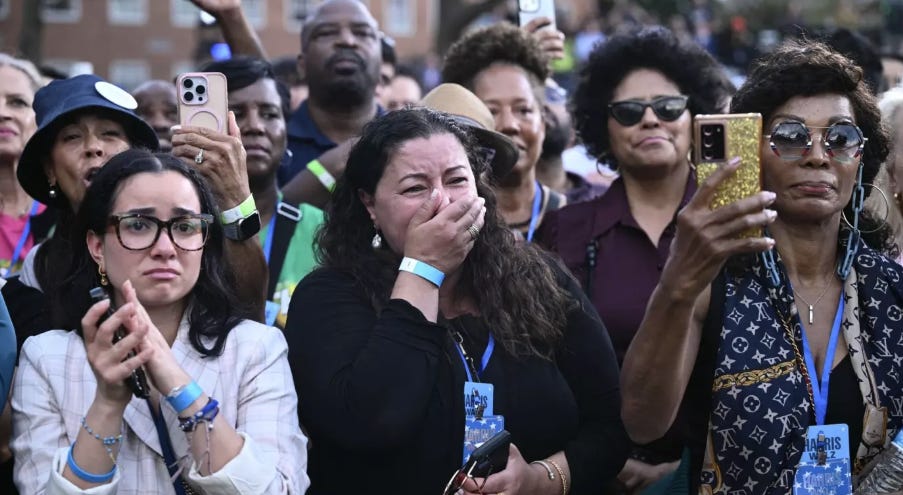
As liberals try to make sense of their devastating loss to a man that many of them had branded as a modern-day Hitler figure, finger-pointing and second-guessing have become the order of the day. Media personalities, Democratic Party leaders, strategists and operatives are scrambling to establish a narrative that places the blame for the loss squarely on anyone and anything other than themselves — in other words, to deflect responsibility for their many failures in terms of policy and messaging.
Soon after Donald J. Trump’s victory over Democratic nominee Kamala Harris, Democrats began casting aspersions on those seen as the most responsible for this calamity, with many blaming the election results on the American people’s bigotry. According to this view, voters are generally just awful people who voted for a fascist because they hate democracy and want to strip rights away from women and people of color. Also, being misogynists, American men dreaded the prospect of a woman president.
Allan Lichtman, for instance, an analyst who the Washington Post and New York Times have hailed as “a political Nostradamus,” excused his failed prediction of a Kamala Harris victory on his underestimation of Americans’ inherent “racism, misogyny and xenophobia.” Senator Chris Murphy (D-Conn.) echoed this theme when he tweeted that the election results reflect men’s “identity crisis, as the patriarchy, society’s primary organizing paradigm for centuries, rightly crashes.”
MSNBC’s Rachel Maddow took this voter-shaming a step further, essentially blaming the American people for collectively deciding to embrace fascism. According to Maddow, 76 million Americans just said, “Hey, what the heck, let’s try the strongman thing. Let’s let democracy go.”
Some Democrats, however, have taken a slightly more introspective approach to explaining their loss, blaming some of the key decisions made over the past several months such as Harris’s selection of Minnesota Governor Tim Walz as her running mate, with one operative observing that he “ultimately offered next to nothing.”
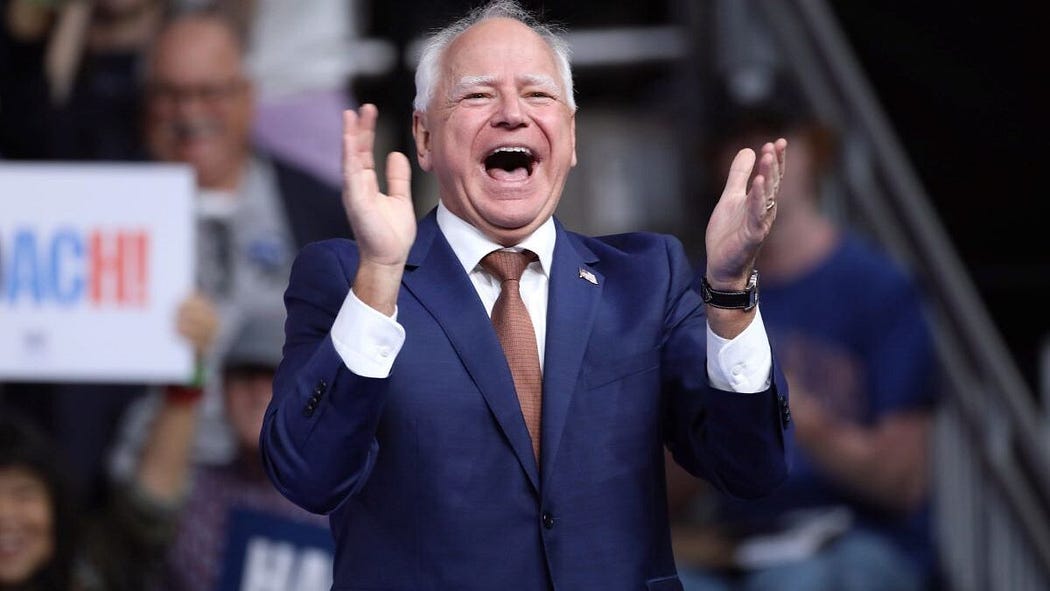
Not only did Walz generally fail to connect with voters, critics say, but he also brought significant unwanted baggage in terms of his serial lying and exaggerating, with many wondering if anything he said could be trusted. Among his many fibs were his supposed triumphs as a high school football coach, his claim to be present in China on the day of the Tiananmen Square massacre in 1989, and falsified military service claims, including what many say amounted to “stolen valor.”
Complaints have also been raised about how the Democrats failed to address the hemorrhaging of support from Latino voters, who had increasingly migrated to the Republican Party in this election cycle. Others see the main problem as President Joe Biden’s tone-deafness on issues such as inflation and illegal immigration, noting that his failure to address voters’ concerns on these issues carried over into Harris’s campaign.
The Harris campaign was also blamed for not effectively articulating its views on LGBTQIA+ issues and failing to respond to Trump campaign advertisements that attacked the left’s supposed devotion to the transgender agenda. One ad that inundated the airwaves in the lead-up to Election Day poked fun at the liberal obsession with pronouns, declaring that “Kamala is for they/them; President Trump is for you.” Former Democratic Pennsylvania Gov. Ed Rendell blamed this ad for costing Harris badly needed votes in his state.
“Week by week when that ad hit and stuck and we didn’t respond,” Rendell said, “I think that was the beginning of the end.” Rep. Tom Suozzi (D-N.Y.) concurred, blaming the election loss on Democrats “pandering to the far left” on trans issues. He admitted to the New York Times following the election that he doesn’t “think biological boys should be playing in girls’ sports.”
This is a widely shared, common sense view, some Democrats said, pointing out that Harris’s stated support for taxpayer-funded “gender-affirming medical care” in prisons and that the Biden-Harris administration’s revisions earlier this year to the Title IX rule that had protected women’s sports for more than 50 years were not exactly winning issues with the electorate.
Further, the insistence that there is no advantage that biological males hold over females in sports was undermined a month before the election with a UN report documenting that the inclusion of biological males in women’s sports has led to hundreds of competitions being lost by women and that the growing trend of transgender women in sports poses a serious risk to female athletes’ physical wellbeing.
With even the United Nations disputing the left’s approach to this issue, it was increasingly clear that the Democrats’ position was nonsensical and indefensible, and was probably costing them votes. College swimmer-turned-activist Riley Gaines drove the point home in an op-ed in October noting that “the Biden-Harris administration has perverted the plain meaning of Title IX by reassigning sex-based protections meant for women and girls to men and boys claiming a female identity.” This, she wrote, “reflects a fanatical adherence to radical gender ideology.”
Following their loss to Trump, increasing numbers of Democrats began to concede this reality. As Rep. Seth Moulton (D-Mass.) observed: “Democrats spend way too much time trying not to offend anyone rather than being brutally honest about the challenges many Americans face. I have two little girls. I don’t want them getting run over on a playing field by a male or formerly male athlete, but as a Democrat, I’m supposed to be afraid to say that.”
Abandonment of the Working Class
The trans issue, however, was just one aspect of Harris’s general failure to connect with average Americans, with some critics contending that the fundamental problem is the party’s steady drift away from its roots. The prioritization of identity politics over economics, as well as the tendency to place the concerns of donors and a well-to-do professional class over the concerns of average people, has led to a revolt against the Democratic Party.
“Why are we losing blue collar working men?” Arizona Secretary of State Adrian Fontes asked. “Because we’re very consistent in our messaging away from them — away from their traditional family values, away from their personal economic concerns and their family’s economic concerns,” he said. “And that is a hard political pill for Democrats to swallow.”
Vermont Senator Bernie Sanders, who ran in the Democratic primaries as an economic populist in 2016 and 2020, agrees. He identified the party’s abandonment of the American working class as the main issue responsible for its electoral woes.
“It should come as no great surprise that a Democratic Party which has abandoned working class people would find that the working class has abandoned them,” Sanders tweeted the day after the election. “While the Democratic leadership defends the status quo, the American people are angry and want change. And they’re right.”
The comments echoed remarks from Teamsters President Sean O’Brien, who had blasted the Democratic Party on Theo Von’s “This Past Weekend” podcast just before the election. “I’ll be honest with you, I’m a Democrat, but they have fucked us over for the last 40 years,” O’Brien told Von.
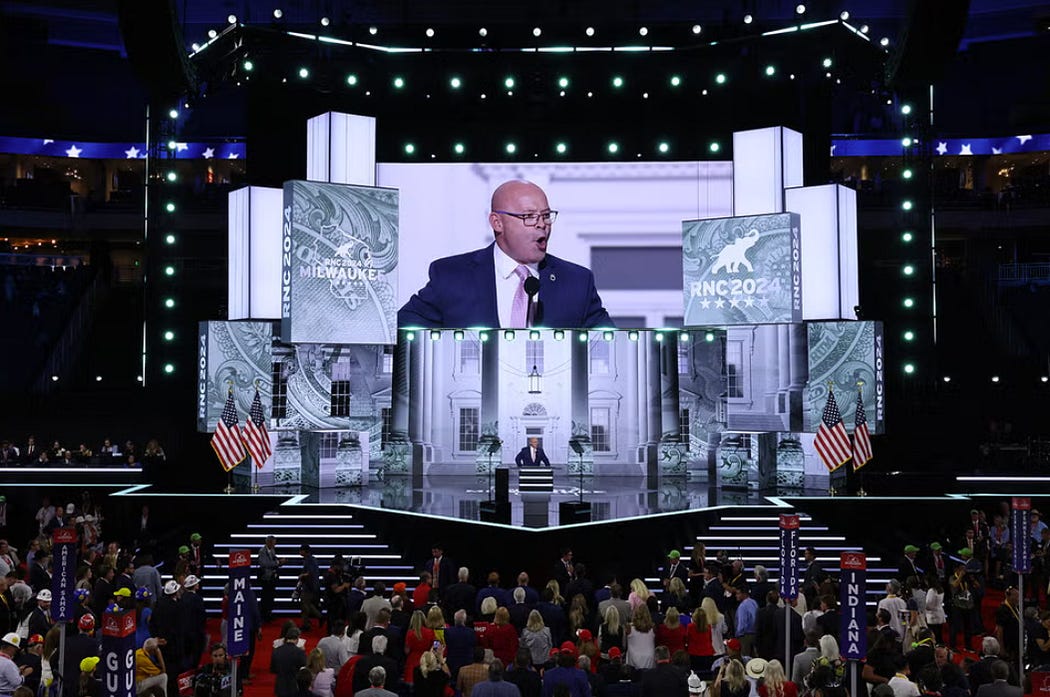
With polls showing that rank-and-file union members overwhelmingly backed Donald Trump, O’Brien said that in Election 2024, Teamsters were “standing up as a union, probably the only one right now, saying, ‘What the fuck have you done for us?’”
While many might have seen these observations about the Democrats abandoning the working class as self-evident and indisputable — albeit with Sanders’s comments coming “sadly late” as former Democrat Robert F. Kennedy Jr. noted — some leaders of the Democratic Party pushed back on the notion that the party had lost its way as a one-time champion of workers.
Sanders’s comments were attacked in particular by the chair of the Democratic National Committee, Jaime Harrison, who called them “straight up BS.” Biden, Harrison claimed, “was the most-pro worker President of my lifetime.”
To be sure, there were a number of positive developments for the labor movement under the Biden administration. Executive orders were issued to improve conditions for work on federal projects and the administration created new rules for pay equity for federal employees. Biden also became the first president to walk a picket line when he joined striking union members at the General Motors’ Willow Run parts center near Detroit in 2023.
At the same time, however, Biden dusted off the Railway Labor Act of 1926 to prevent the railroad union from striking for better sick leave in 2022, arguing that the economy could not afford a rail shutdown. “Biden just knifed labor unions in the back” by breaking the railroad strike, labor reporter Hamilton Nolan observed. “They shouldn’t forget it.”
With this mixed record in mind, labor unions generally give Biden high marks but not a perfect score, and the Teamsters declined to endorse either Harris or Trump. O’Brien, the Teamsters president, also made history by speaking at the Republican National Convention in July, praising Donald Trump for having “the backbone to open the doors” to his union and declaring that “Teamsters are here to say we are not beholden to anyone or any party.”
Former Speaker of the House Nancy Pelosi, in response to Sanders’s criticism of the Democrats’ abandonment of the working class, retorted that she doesn’t “respect him saying that the Democratic Party has abandoned the working class families,” but seemed to have trouble describing any tangible benefits that the working class has enjoyed under the Biden administration.
While attempting to push back on Sanders’s assessment, Pelosi was grasping at straws for an example of pro-worker policies that Biden has implemented. She oddly pointed to COVID relief measures as proof that Democrats in fact do support the working class.
“Under President Biden, you see the rescue package, money in the pockets of people, the shots in the arm, children in school safely, working people back to work,” Pelosi said.
But even as she defended the Democratic Party’s track record, Pelosi conceded that mistakes were made in the lead-up to Election 2024. In particular, she admitted that it would have been a good idea to hold an open primary and ultimately blamed Biden’s reluctance to bow out of the 2024 presidential election as the main cause of the Democrats’ failures.
“Had the president gotten out sooner,” Pelosi said, “there may have been other candidates in the race. The anticipation was that, if the president were to step aside, that there would be an open primary.”
In this regard, however, Pelosi was being a bit coy. The reality is that there were several challengers seeking the Democratic Party’s nomination, but at the time that it mattered, the party chose to sideline those candidacies rather than facilitate an open and competitive process. This, along with attempts to remove Donald Trump from the ballot in a number of states and unprecedented efforts to suppress independents and third parties, undermined party messaging on the election being a referendum on America’s democratic traditions.
Abandonment of Democracy
In fact, despite Joe Biden declaring that the question of “whether democracy is still America’s sacred cause is what the 2024 election is all about,” the Democrats showed little interest in respecting democratic principles during this electoral cycle.
After a number of candidates declared their intention to take on President Biden at the beginning of the primary process in the spring of 2023, the party establishment took steps to make sure that these candidates would not be able to compete on a level playing field with the president, nor would Americans even be made generally aware that there were primary challengers for them to choose from.
As Democratic Party insider Symone Sanders pointedly stated in May 2023, “the Democratic National Committee will not facilitate a primary process.” She added that “there will be no debate stage for Bobby Kennedy, Marianne Williamson or anyone else.” Speaking on MSNBC’s “Morning Joe,” Sanders said that the DNC is “not going to set up a primary process for debate to — for someone to challenge the head of the Democratic Party.”
Not only did the DNC make clear that it would not hold open debates between Biden and his primary challengers, but it also decided to move the first primary from New Hampshire — where Biden had performed poorly in 2020 — to the more Biden-friendly state of South Carolina. The strategy seemed to be designed to ensure that the first contest resulted in a clear victory for Biden to help cement the image of his nomination’s inevitability.
This led to complaints that the DNC was stacking the deck. Marianne Williamson, the first officially declared primary challenger, said the primary system was being “rigged” in favor of President Biden, asserting on ABC’s “This Week” that the Democratic establishment is “not even covert about their swaying the primary season. They’re very overt about it.”
She claimed that the DNC had “infiltrated staff at the highest levels to sabotage the campaign” as part of a strategy to “make sure she doesn’t get anywhere.” Williamson regretted that the effect of this was “suppressing the kind of robust conversation that democracy requires,” insisting that “the DNC should not be rigging this system.”
Other primary challengers agreed, including Robert F. Kennedy Jr.
In a letter to DNC Chair Jaime Harrison, the Kennedy campaign complained that the Biden campaign appeared to be directly involved in shaping the DNC’s primary rules and that the DNC had created a new class of superdelegates — in contravention of the restrictions on superdelegate voting power implemented after the debacle of 2016 — who were empowered to thwart the will of the people.
All of these shenanigans had the effect of undermining the primary process and ultimately led to Kennedy declaring his independent candidacy in October 2023, while Williamson, Dean Phillips and Jason Palmer continued their quixotic bids for the Democratic Party nomination. Needless to say, Biden won easily.
As the Associated Press reported on March 13, 2024, “Biden became his party’s presumptive nominee when he won enough delegates in Georgia,” adding that the president “did not face any serious Democratic challengers … despite facing low approval ratings and a lack of voter enthusiasm for his presidency.”
Abandonment of Reality
For years, of course, the Democratic Party had insisted that President Biden was not only fit for office but that he was “sharp as a tack,” the preferred phrase repeatedly endlessly by TV talking heads and Democratic partisans trying to shore up his image as a capable leader. MSNBC host Joe Scarborough even went so far to say that “this version of Biden — intellectually, analytically — is the best Biden ever.” The Associated Press was a bit more nuanced, asserting that Biden was “often sharp and focused but sometimes confused and forgetful.”
With Democrats insisting that the 81-year-old Biden was as mentally fit as ever, his daily verbal gaffes were chalked up to a lifelong stuttering problem, while his odd behavior captured on camera — such as turning away from a group of world leaders at a G7 event in France or seemingly being led off the stage by former President Obama at a fundraiser — were nothing but creatively edited “cheap fakes,” as White House Press Secretary Karine Jean-Pierre absurdly claimed.
The “cheap fakes” excuse was effectively demolished, however, when the country watched the Trump-Biden debate in late June.
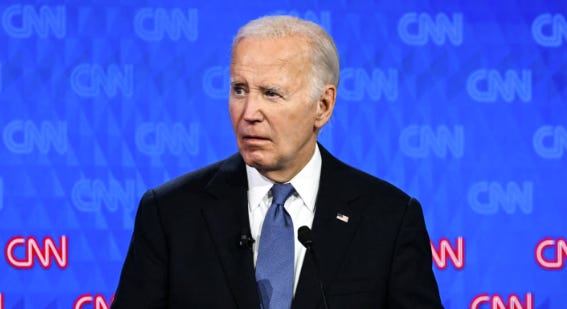
During this debate, Biden was repeatedly caught on camera with his mouth agape and staring blankly into space. The president had trouble completing sentences and could not articulate simple thoughts, leading many to conclude that it was time for him to go. Suddenly, the party elites and the establishment media that had covered up his mental decline had discovered that maybe Biden was unfit to run for re-election after all.
It soon became obvious what a mistake the Democrats had made in not holding an open primary, with Biden’s poll numbers tanking and his chances of re-election dwindling by the day. By early July, his approval rating had dropped to 38.8 percent while his disapproval ranking was at 58.1 percent. His chances against Trump did not look promising.
But by the time reality caught up with the Democratic Party and the president’s severe cognitive issues became so obvious that the party could no longer deny them, it was too late to organize a second round of primary elections before the Democratic National Convention scheduled to begin on August 19.
So, instead of having a democratic process, the party pulled what had the appearance of a soft coup, with major donors reportedly threatening to halt contributions and party leaders applying concerted pressure to force Biden to step down. He was replaced with Harris — despite her not receiving a single vote during the primaries — who would be anointed the nominee at the Democratic National Convention.
Meanwhile, a Zogby Strategies poll showed Kennedy beating Donald Trump by 14 points in a head-to-head matchup, while his favorability rankings placed him neck and neck with Trump and Harris. Notably, while Trump’s unfavorability rating was at 54.8 percent and Harris’s was at 54.7 percent, just 40.8 percent had an unfavorable view of RFK Jr. — despite overwhelmingly negative media coverage painting him as an “anti-vaxxer” and “conspiracy theorist.”
With Kennedy perceived as a threat who could possibly “siphon votes” from Harris, the Democratic Party focused on sabotaging his campaign. In a podcast interview that aired Aug. 20, Kennedy’s running mate Nicole Shanahan described the innumerable obstacles that had been erected by Democrats to suppress Kennedy’s independent run.
“Clear Choice, this DNC-aligned PAC that was created specifically to take us out, has spent millions of dollars to take us out,” Shanahan said. “They have banned us, shadowbanned us, kept us off stages, manipulated polls, used lawfare against us, sued us in every possible state, they’ve even planted insiders into our campaign to disrupt it and create actual legal issues for us.”
In attempting to overcome these obstacles, the Kennedy campaign was forced to spend millions of dollars fighting legal challenges in multiple states. Nevertheless, the campaign managed to secure spots on the ballot in all 50 states, submitting more than a million signatures across the country, “something no presidential candidate in history had ever achieved,” Kennedy pointed out.
Ultimately, though, Kennedy determined that he had no path to victory and feared that his candidacy would help the Democrats win in November, so he ended his campaign and joined the Trump campaign. Pre-election polls indicated that this move gave Trump a major boost in swing states, with 56 percent of Kennedy voters planning to vote Trump and just 34 percent planning to vote Harris.
As Kennedy’s PAC American Values pointed out, “Throughout the campaign, Kennedy’s support in these states ranged from almost 30% to mid-single digits. Even if we accept the most conservative estimates of his support (3–5%), that group was still easily large enough to decide the race in swing states.”
With these numbers in mind, it was clear that if the Democrats had simply lived up to their claims of supporting democracy and committed to holding a fair primary election last year, they could have ended up with a nominee like Kennedy who voters actually liked. Instead, they ended up with Kamala Harris, a deeply flawed candidate known for her incessant cackling and word salads who had a 49.5 percent unfavorability rating on the eve of the election.
In other words, the underlying problem facing the Democratic Party is not that America is fundamentally racist or misogynistic, or even that the Harris campaign failed to articulate a winning message on core issues such as the economy and cost of living — it is that Democrats have abandoned the working class, democratic elections, and a basic commitment to reality.
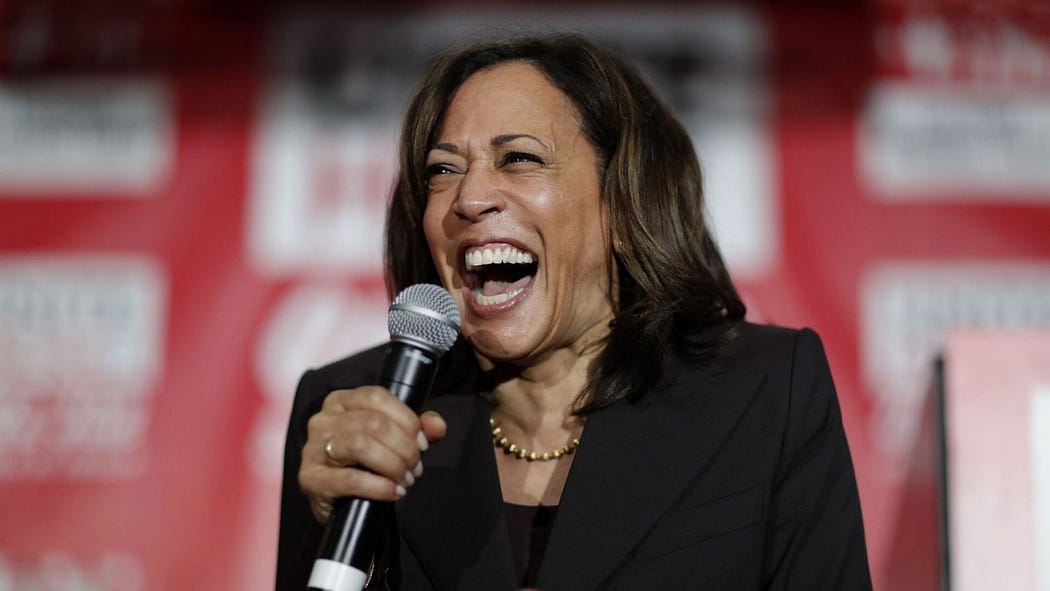
This was seen in the Democrats’ failure to acknowledge President Biden’s unfitness for office, as well as their approach to controversial issues such as transgender rights or the insistence that the failure to secure the southern border was all the Republicans’ fault. It was also seen in their attempts to prop up Harris as a viable candidate, despite the overwhelming reality that Americans just didn’t like her — having decidedly rejected her four years earlier in her failed bid for the 2020 Democratic nomination.
This cognitive dissonance finally caught up with the Democrats. While they apparently thought that they could continue to gaslight the American people and that a parade of celebrity endorsements would convince voters to accept their version of reality, Americans apparently had a different view.
Ultimately, of course, it is impossible to say how much of a role any one particular policy issue or party decision during this election cycle impacted the results, but what is clear is that the Democrats’ inability to “read the room” cost them dearly needed support. From cultural issues to economic policies to basic political calculations, the Democratic Party repeatedly dropped the ball, and paid the price on Election Day.
Nat Parry is the author of Samuel Adams and the Vagabond Henry Tufts: Virtue Meets Vice in the Revolutionary Era and How Christmas Became Christmas. He is the editor of American Dispatches: A Robert Parry Reader. Follow him on X.